
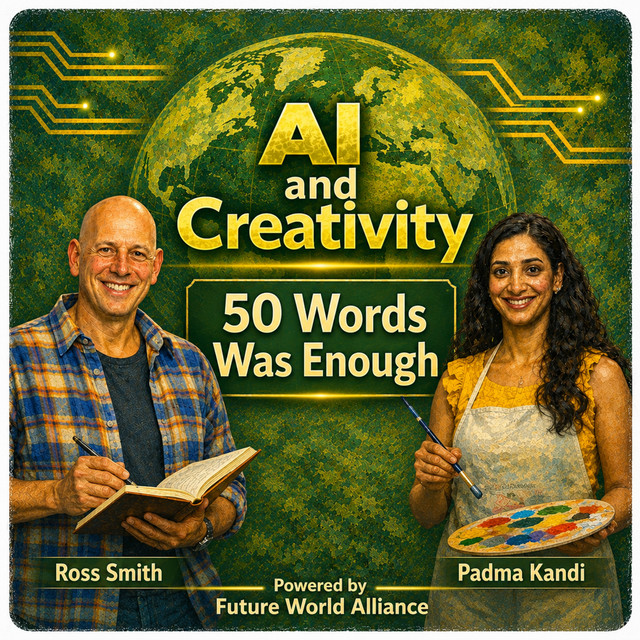
50 Words Was Enough: What Constraints Teach Us About Creativity
We treat freedom as the ideal condition for creative work. A blank page, unlimited time, no rules. Do whatever you want. Go wherever the idea takes you. The…
Show notes
We treat freedom as the ideal condition for creative work. A blank page, unlimited time, no rules. Do whatever you want. Go wherever the idea takes you. The assumption is that the fewer the limits, the better the work.
But some of the most celebrated creative work in history was born from the tightest cages imaginable. And the story of how one children’s book came to be might be the best illustration of why.
The Bet That Made a Classic
In 1960, Theodor Seuss Geisel: Dr. Seuss, made a wager with his editor and publisher Bennett Cerf. The terms: Seuss could not write a compelling, publishable children’s book using a vocabulary of only 50 unique words. Not 50 words total. Fifty distinct words, used in any combination, as many times as needed.
Cerf put up $50. Seuss got to work.
The result was Green Eggs and Ham, one of the best-selling children’s books ever printed, with over 200 million copies sold. The constraint didn’t produce a lesser book. It produced that book: relentlessly rhythmic, endlessly re-readable, perfectly calibrated for the young minds it was written for.
Cerf reportedly never paid up.
The detail that gets lost in the retelling is the distinction between total words and unique words. It matters because the constraint wasn’t about brevity, it was about vocabulary. Seuss had to tell a full story, with character and conflict and resolution, using the same small pool of building blocks over and over. The limitation forced a kind of linguistic ingenuity that a wider vocabulary would have made unnecessary. He couldn’t reach for a better word. He had to make the words he had do more.
That’s the constraint working exactly as it should.
Why Constraints Work
The paradox of creative freedom is that too much of it produces paralysis, not possibility. A blank canvas with infinite options is overwhelming. The first decision, what color, what word, what note, carries the weight of every other decision that will follow it. Most people freeze.
Constraints solve this. They work in at least three distinct ways.
First, they cure the blank-page problem. A constraint eliminates options before you begin, which means the first decision is already made for you. You’re not choosing from everything, you’re choosing from what the constraint allows. That’s a workable problem.
Second, they force originality. When the obvious path is blocked, you can’t fall back on clichés or defaults. The constraint demands you find a new route, which is usually where the interesting work lives. Seuss couldn’t write “famished” when he’d used up his vocabulary. He had to find another way.
Third, they sharpen and define the work. By ruling out what something won’t be, constraints clarify what it is. They make success legible, you know when you’ve solved the problem because the constraint tells you what “solved” looks like.
The deeper principle: creativity isn’t about pure freedom. It’s about meaningful choice, and constraints are what make choices meaningful.
Constraints in the Wild
Seuss isn’t alone. Once you start looking, constraints are everywhere in the history of creative work.
The French novelist Georges Perec wrote La Disparition in 1969, a full-length, 300-page novel without using the letter “e” anywhere in the text. This technique, called a lipogram, wasn’t a party trick. Perec was a member of Oulipo, a French literary movement that used self-imposed mathematical and structural constraints as a deliberate method of generating new work. The movement also included Italo Calvino. Their core belief: restrictions don’t limit creative work, they produce it.
In film, Lars von Trier co-created the Dogme 95 manifesto, a set of rules requiring films to be shot on location with handheld cameras, no added sound, no non-diegetic music, and no genre conventions. The rules were designed to strip cinema back to what von Trier saw as its honest core. Festen and The Idiots emerged from this framework, raw, immediate, unlike anything made under standard Hollywood conditions.
In music, Jack White of The White Stripes has spoken openly about using constraint as a creative philosophy. Limiting the band to two members, and deliberately making his guitar harder to play, forced choices he never would have made with easier tools. Bach’s fugues, written centuries earlier, operated on the same principle, extreme formal rules applied to melody and counterpoint that required each musical idea to work simultaneously in multiple configurations.
And then there’s Beethoven, who composed some of his greatest work, including the Ninth Symphony, after going completely deaf. The constraint there wasn’t chosen. But the principle still held.
Constraints You Can Use Today
You don’t need a $50 bet or a manifesto to put this into practice. Some of the most effective creative constraints are the simplest to impose:
Time: Give yourself half the time you think you need. Urgency destroys perfectionism faster than anything else. Set a timer and ship whatever exists when it goes off.
Scope: One idea per piece. One argument, one image, one emotion. If you can summarize your work in a sentence and it requires the word “and,” cut something.
Process: No editing until the entire first draft exists. Forward only. The inner critic and the creator cannot be in the room at the same time.
Form: Borrow a structure with rules already built in, a sonnet, a five-slide deck, a one-sentence summary. The form carries centuries of solved problems. Use them.
Randomness: Let something arbitrary make a decision for you. A random word as a mandatory starting point. The opposite of your first instinct. A die roll to determine a key variable.
The best constraint is one that feels slightly too tight, uncomfortable enough to force ingenuity, loose enough that solving it is still possible.
AI as a Constraint Partner
Here’s where creative practice in 2026 gets genuinely interesting: AI tools can function as a powerful constraint engine, if you use them the right way.
The wrong way is to ask AI to do the creative work for you. That removes constraint entirely, you get an answer without a problem, which produces nothing worth keeping.
The right way is to use AI as a foil. Here are five specific approaches:
The Constraint Generator. Ask AI to invent rules for you, especially strange cross-disciplinary ones. “Give me 10 unusual constraints for a short story.” “What rules from jazz composition could I apply to graphic design?” AI has absorbed enough domains to make connections that would take a human years of reading to stumble across. You pick the one that makes you slightly uncomfortable, and go.
The Artificial Editor. Hand AI a piece of your work and a brutal constraint, and ask it to enforce it. “Rewrite this with no adjectives.” “Cut this to exactly 100 words without losing the core idea.” You’re not using the output as your final draft, you’re using it as a mirror to see what your work looks like under maximum pressure, then rewriting it yourself with that pressure in mind.
The Wrong-Tool Translator. Ask AI to render your idea through a completely mismatched form. “Explain this business strategy as if it were a recipe.” “Write this apology as stage directions.” “Describe this product using only the vocabulary of a 19th-century naturalist.” What survives the translation is usually the actual essence of your idea, the thing you needed to find all along.
The Rapid Variation Engine. Once you have a strong constraint, use AI to generate many variations fast, so you can see the shape of the solution space before committing. Twenty versions of a tagline. Fifteen possible titles. Ten openings for the same essay. You’re not looking for AI to pick the winner, you’re using volume to train your own judgment and spot patterns you couldn’t see from one or two attempts.
The Pressure-Tester. Describe a constraint you’re considering and ask AI to stress-test it before you begin. “What problems will I run into? What’s been done before under this constraint? What might this unlock that a looser approach wouldn’t?” This turns AI into a thinking partner that maps the implications of a constraint before you’re 40 pages in and stuck.
In every case, the dynamic is the same: you’re using AI as a collaborator on the edges of the work, not the center. The constraint is yours to choose. The struggle is yours to have. The work is yours to make.
The Box Is the Point
Bennett Cerf thought he had Seuss. Fifty unique words seemed like an impossible cage for a storytelling imagination that big. Instead, the cage became the work, and the work became one of the most-read books in the history of children’s literature.
That’s not a coincidence. It’s not even a surprise, once you understand how creativity actually functions.
Pick one constraint today. Just one. A time limit, a word count, a rule that blocks your first instinct. Start something inside it.
The box isn’t the enemy of your creativity. It might be the whole point.
Latest episodes
 July 28, 2026 · 7 minThe Gap that won’t CloseWhy AI Might Be the Best Tool We’ve Ever Built for Staying Curious
 July 23, 2026 · 5 minWhat J.R.R. Tolkien Can Teach Us About AI and CreativityOverview
 July 15, 2026 · 6 minSteering Away From the Middle: What the Great Creators Teach Us About Using AIIn 1965, driving his family toward Acapulco for a holiday, Gabriel García Márquez is said to have heard the opening voice of One Hundred Years of Solitude…