
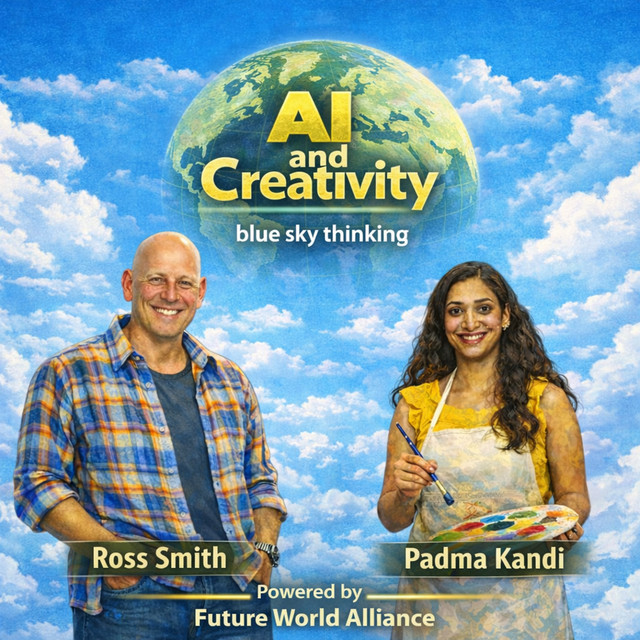
AI and Blue-Sky Thinking: How to Expand Your Creative Horizon
In a world that often demands efficiency and “correct” answers, the concept of Blue Sky Thinking, unconstrained, open-minded exploration, can feel like a…
Show notes
In a world that often demands efficiency and “correct” answers, the concept of Blue Sky Thinking, unconstrained, open-minded exploration, can feel like a luxury. Many of us operate under the “Myth of the Born Creative,” believing that the ability to conjure brilliant ideas is a gift bestowed at birth. However, neuroscience and creativity research tell a different story. Creativity is not a fixed trait; it is a posture toward life and a cognitive muscle that can be strengthened through intentional practice.
The Biological Blueprint of Imagination At its core, creativity is a feat of neuro-executive functioning. When we engage in Blue Sky Thinking, we aren’t just “daydreaming”; we are training our brains to move beyond semantic memory, the warehouse of things we already know, into the realm of divergent thinking. Research into creativity training shows that consistent engagement with new ideas can lead to measurable improvements in originality, fluency, and elaboration.
Psychologists often distinguish between “Big-C” creativity (the world-changing genius of a Da Vinci) and “little-c” creativity (the everyday problem-solving we all do). The secret to a high-level creative life is realizing that the bridge between the two is Creative Self-Efficacy: the simple, profound belief that you are capable of producing something new.
Cultivating a Creative Micro-Environment Our surroundings play a silent but pivotal role in how far our “Blue Sky” reaches. Research suggests that a strong “sense of place” and positive social relationships within our immediate environment, whether a classroom, an office, or a home studio, significantly predict higher creative output.
This is why building a “Muse Council” is so effective. By surrounding yourself with diverse influences, from the polymathic brilliance of Joseph Campbell to the raw emotional honesty of Van Gogh, you create a psychological safety net. When you feel supported by your environment and your “peers” (real or historical), you are more likely to take the intellectual risks necessary for true innovation.
The Rhythm of Input and Output One of the greatest obstacles to creativity is the fear of the “blank page,” but this block often stems from a misunderstanding of the creative rhythm. Creativity requires an oscillation between input and output. There are seasons for “absorbing the world”, reading, traveling, and gathering data, and seasons for “producing.”
A powerful habit to bridge these phases is the practice of “Morning Pages.” By engaging in three pages of stream-of-consciousness writing every morning, you perform a “brain dump” that clears mental clutter. This practice doesn’t just empty the mind; it creates the vacuum necessary for unexpected insights to rush in. When we treat time not as an enemy but as a negotiated constraint, we find that we don’t need “perfect” conditions to create; we just need a routine that honors the process.
The Human Responsibility in an AI World In the modern era, the rise of Artificial Intelligence has left many creators feeling uneasy. However, the most forward-thinking philosophy views AI not as a threat, but as a mirror. It reflects the quality of our own prompts, ambitions, and intentions. If our creative output feels stagnant, it is rarely because the tools have failed us; it is because we have stopped pushing the boundaries of our own curiosity. In a world of automated content, the human responsibility is to provide the meaning and intention that machines cannot replicate.
The Call to Creative Courage Ultimately, a creative life is not about the pursuit of a single masterpiece; it is about the pursuit of range. It is about the courage to be a polymath, to write, paint, code, and imagine across a dozen different domains without the paralyzing fear of judgment.
You have been given a remarkable piece of biological machinery designed specifically to imagine worlds that do not yet exist. Do not let it sit idle. Your greatest contribution to the world is not just the work you produce, but the example you set. When you choose appetite over apathy, and curiosity over comfort, you grant everyone around you the silent permission to do the same.
The blue sky is not a limit; it is an invitation. Step out into it. The horizon is much wider than you think, and your mind was built to fly across it. It is time to stop protecting what is human and start expanding it. Choose to create, choose to explore, and watch as your world expands to meet the scale of your imagination.
References:
Beaty, R. E. (2020). The Creative Brain. Cerebrum. This article from the Cognitive Neuroscience of Creativity Lab at Penn State provides the foundation for the “Big-C” vs. “little-c” distinction. It explains how psychologists measure creative thinking through fluency and originality and explores the neuroscientific question of whether creativity can be enhanced through intervention.
Vally, Z., et al. (2019). Examining the effects of creativity training on creative production, creative self-efficacy, and neuro-executive functioning. Thinking Skills and Creativity. This study is crucial for the argument that creativity is a “muscle.” It demonstrates how structured creativity training leads to substantial improvements in creative self-efficacy (the belief in one’s own creative ability) and enhances the “neuro-executive” functions required to produce original and elaborate work.
Zhang, J., et al. (2023). Stimulating creativity in the classroom: examining the impact of sense of place on students’ creativity and the mediating effect of classmate relationships. BMC Psychology. This research highlights the environmental aspect of creativity. It provides evidence that a “sense of place” and the quality of peer relationships (like the “Muse Council” mentioned in the post) are significant predictors of creative output, proving that our surroundings directly influence our ability to think “Blue Sky.”
Follow us on Spotify:
Latest episodes
 July 28, 2026 · 7 minThe Gap that won’t CloseWhy AI Might Be the Best Tool We’ve Ever Built for Staying Curious
 July 23, 2026 · 5 minWhat J.R.R. Tolkien Can Teach Us About AI and CreativityOverview
 July 15, 2026 · 6 minSteering Away From the Middle: What the Great Creators Teach Us About Using AIIn 1965, driving his family toward Acapulco for a holiday, Gabriel García Márquez is said to have heard the opening voice of One Hundred Years of Solitude…