
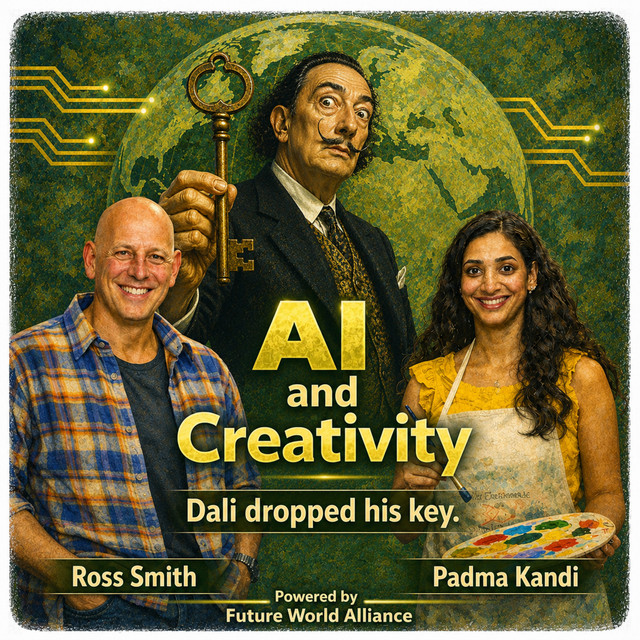
Dali dropped his key - the AI: Sleep Connection
Dali dropped his key - the AI: Sleep Connection
Show notes
Dali dropped his key - the AI - Sleep Connection
Somewhere in the architecture of your skull, a seahorse is dreaming. The hippocampus, named for its resemblance to a seahorse, is the brain’s unified organ for memory, imagination, and creativity. Research from Roger Beaty shows it lights up identically whether you are recalling the past or generating a genuinely original idea. At night, this “seahorse” goes to work without you, sorting the day’s experiences and weaving them into the vast web of everything you’ve ever known.
Salvador Dalí and Thomas Edison both understood that the mind becomes strangely fertile at the edge of sleep. Dalí would sit in a chair holding a heavy key over a metal plate, drifting into hypnagogia until the key slipped from his fingers and crashed to the floor, waking him just as dream imagery began to bloom. Edison used a remarkably similar technique, resting with steel balls in his hands so that when sleep overtook him, the balls would fall and wake him before deeper sleep erased the fragile ideas forming in his mind. Neither man treated sleep as passive rest; they treated the twilight between waking and dreaming as a laboratory for invention and imagination, where the brain’s usual rules loosened and distant ideas could suddenly connect. Long before AI existed, they were already engineering the threshold state that modern neuroscience now recognizes as one of the brain’s richest environments for creative insight.
Today, however, most of us feed this system “intellectual gas station sushi” before bed, doomscrolling or checking emails on our phone before we close our eyes. Or we finish the final episode of our binge-watching and head to bed. To truly unlock our creative potential, we must move beyond passive rest and toward dream engineering. By using AI as a narrative partner, we can intentionally seed our sleep with the ingredients for breakthrough.
The Twilight Zone: The N1 Creative Sweet Spot
Deep research reveals that the most fertile ground for insight isn’t deep sleep, but the “twilight zone” between wakefulness and rest, known as N1 or hypnagogia. A study from the Paris Brain Institute published in Science Advances found that spending just 15 seconds in this N1 state tripled the chance of discovering hidden rules to a complex problem. Participants who hit this “creative sweet spot” had an 83% success rate, compared to only 30% for those who stayed awake.
The mechanism at play is “associative divergence.” In N1, the brain’s analytical guard, the prefrontal cortex, begins to lower, allowing the Default Mode Network to cross-pollinate ideas that daylight logic would keep separate. But there is a catch: if you fall too deeply into N2 sleep, the creative “aha!” moment often vanishes.
Hypnagogia, the strange threshold between waking and sleep, may be one of the brain’s most fertile creative states. In this twilight zone, the analytical guard of the mind begins to lower while associative networks become unusually active, allowing distant ideas, memories, emotions, and symbols to connect in ways that daylight logic normally suppresses.
Researchers studying N1 sleep have found that even brief periods in this state can dramatically increase creative insight and problem solving. The key to invoking hypnagogia is not stimulation, but gentle narrative occupation: reducing cognitive noise, dimming lights, lying down before exhaustion, and feeding the mind emotionally resonant but unresolved material. This is where AI becomes something more than a productivity tool. Instead of asking AI to solve your problem directly, ask it to tell you a slow, symbolic story that “breathes near” your problem without touching it, a four-minute story spoken aloud in a calm voice, ending unresolved. As the brain drifts toward sleep, that unfinished narrative becomes a cognitive seed the hippocampus continues processing in the dark, transforming AI from an answer engine into a collaborator for the dreaming mind.
Practical AI Strategy: Designing the Narrative Seed
This is where Artificial Intelligence becomes a functional creative tool. Instead of staring at a “blank page” problem, use AI to create an Open Narrative Loop.
The Prompting Strategy: Don’t ask the AI to solve your problem. Instead, ask it to “breathe near it without touching it.” If you are struggling with a business strategy, ask the AI: “Tell me a short story about a bridge builder in a fog-heavy valley who discovers a way to support weight using only the wind. End the story just as the first traveler steps onto the bridge.”
Three suggested prompts
For a career or life decision you can’t resolve: “Tell me a slow, quiet story about a lighthouse keeper who has kept the same light burning for twenty years, who one night receives a letter offering her a different shore entirely. Don’t tell me what she decides. End with her standing at the window, the letter still in her hand, the light still turning.”
For a creative project you’re stuck on: “Tell me a story about an architect who has been designing the same room for a year, every version almost right, but not quite. One evening she stops drawing and simply sits in the unfinished space. Something she hasn’t noticed before is in the corner. End there, before she looks directly at it.”
For a problem involving other people, a difficult conversation, a collaboration, a conflict: “Tell me a story about two musicians who have played together for years but have never once played in the same key. Tonight, one of them arrives early and starts playing alone. Tell me what the room sounds like before the other one walks in.”
The Delivery: Listen to the response using AI voice-to-speech in the dark. Research on auditory processing shows that as we cross into hypnagogia, sound is still absorbed but interpreted with the loose logic of the dreaming mind. The voice’s emotional prosody, its tone and weight, activates the limbic system, flagging the material as significant for the hippocampus to return to during the night.
The REM Integration: Restructuring the Puzzle
Once you move past the initial sleep onset, the brain enters REM (Rapid Eye Movement) sleep. While N1 ignites the spark, REM sleep is where the heavy lifting of “support intelligence” happens.
A study in Neuroscience of Consciousness demonstrated that “dream engineering” using auditory cues during REM sleep could guide dream content toward specific unsolved puzzles. This Targeted Memory Reactivation (TMR) allows the cognitive unconscious to methodically cross-reference your open narrative loop against every unresolved question you carry. Researchers at Ohio State, like Fletcher and Benveniste, identify narrative cognition as the brain’s primary non-computational engine, it thinks in actions and consequences rather than categories and lists.
Human Augmentation: The Morning Harvest
To make this practical, your AI partner can act as your “scribe of the twilight.”
The Loading Phase: Use AI to generate three “semantic distant” metaphors for your current project.
The Incubation: Listen to these stories as you drift into N1, perhaps using a light alarm or the “Edison technique” (holding an object that drops when you relax) to wake yourself briefly and capture initial sparks.
The Synthesis: Upon waking, immediately dictate your “dream fragments” back to the AI. Use a prompt like: “Here are three images from my sleep. Connect these to the ‘bridge builder’ story from last night and find the strategic pivot for my current project.”
Research shows that loading the mind with vivid, emotionally resonant material produces not just more ideas, but more varied and surprising ones. The seahorse doesn’t need you to solve the problem with brute force; it needs you to give it something worth dreaming about. By using AI to curate those dreams, we turn sleep from a period of lost time into our most productive creative laboratory.
Latest episodes
 July 28, 2026 · 7 minThe Gap that won’t CloseWhy AI Might Be the Best Tool We’ve Ever Built for Staying Curious
 July 23, 2026 · 5 minWhat J.R.R. Tolkien Can Teach Us About AI and CreativityOverview
 July 15, 2026 · 6 minSteering Away From the Middle: What the Great Creators Teach Us About Using AIIn 1965, driving his family toward Acapulco for a holiday, Gabriel García Márquez is said to have heard the opening voice of One Hundred Years of Solitude…