
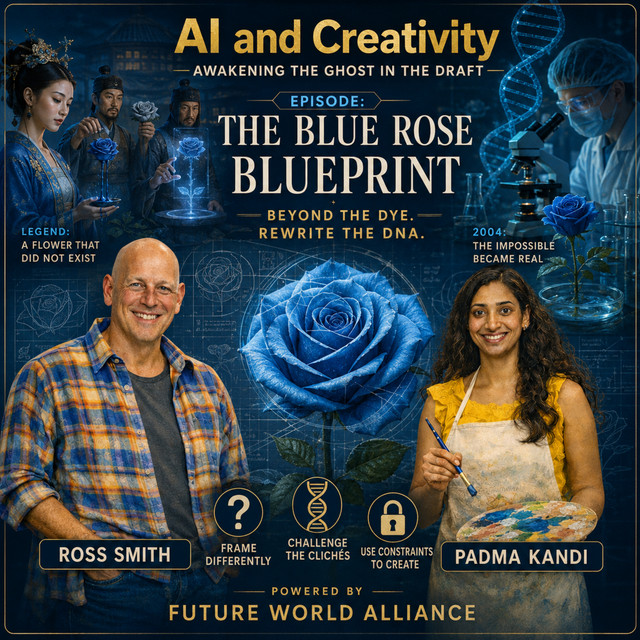
The Blue Rose Blueprint
How an Ancient Legend and Artificial Intelligence Can Shatter Your Creative Limits
Show notes
How an Ancient Legend and Artificial Intelligence Can Shatter Your Creative Limits
For centuries, the blue rose has lived entirely in the territory of the imagination. Because nature lacks the specific genetic machinery required to generate a blue pigment in roses, the flower became the ultimate cultural shorthand for the impossible, the unattainable, and the deeply mysterious. It was a symbol of dreams too wild to be realized, chased by romantic poets and alchemists alike.
But the true power of the blue rose is not that it is missing from nature. Its power lies in how it forces us to think. When faced with an impossible problem, how do we innovate? By exploring the deep folklore of the blue rose and combining it with modern artificial intelligence, we can build a systematic framework for radical creativity.
1. The Myth: The Pitfalls of Fake Novelty
The most enduring legend of the blue rose comes from ancient China. An Emperor’s daughter, fiercely independent and brilliant, declared she would only marry the suitor who could bring her a natural blue rose from the earth. Desperate to win her hand, three powerful men attempted to solve this impossible challenge through trickery, superficial gloss, and brute force.
• The Prime Minister’s Son bribed a master florist to saturate a pristine white rose with deep blue dye. The princess instantly saw through the ruse as the chemical color began to drip from the petals, rejecting him for his shallow deceit.
• A Wealthy Warrior commissioned an elite jeweler to forge a breathtaking sapphire, exquisitely carved into the likeness of a rose. The princess admired its craftsmanship but rejected it because it was a cold, lifeless stone, not a true flower.
• A Brilliant Scholar collaborated with a master illusionist to project a holographic blue light over a standard white rose. The moment the princess reached for it, her fingers slipped through empty air, exposing the performance.
Finally, a penniless minstrel whom the princess truly loved arrived at the palace. He offered her nothing more than a common, fragrant white rose. Looking into his eyes, she smiled and announced to the court, “This is a true blue rose.” The Emperor, bound by his own decree and seeing his daughter’s genuine heart, permitted the marriage.
The Creative Blueprint: The first three suitors failed because they relied on gimmicks, imitation, or superficial gloss. In creative work, the “dye” is changing a font or adding a buzzword. The “sapphire” is throwing massive tech or money at an empty project. The “illusion” is style over substance. True creativity requires changing the underlying DNA of an idea, or entirely rewriting the rules of engagement.
2. Cultural Symbolism: The Architecture of Yearning
Because the blue rose did not exist, its symbolism evolved across global cultures to represent the absolute limit of human aspiration. In Western Romanticism, introduced beautifully by the poet Novalis, it became the “Blaue Blume”, a symbol of infinite longing (Sehnsucht) and the intersection of human art with the mystical. To chase the blue flower meant you refused to accept the world as it was currently handed to you.
To be an exceptional creator, you must actively harness this framework. If you aim for a safe, predictable outcome, you will achieve a safe, predictable product. True breakthroughs occur when you deliberately aim for a “blue rose”, a concept that seems fundamentally absurd or structurally impossible, forcing your brain to build entirely new neurological bridges to close the gap.
3. The Human-AI Metamorphosis: Cultivating the Blue Rose
In 2004, the legend shifted. Through decades of biotechnology and genetic engineering, scientists successfully synthesized a blue rose by introducing a delphinium gene into a rose’s DNA. What was once a biological impossibility became reality through precise engineering.
Today, generative AI represents that exact evolutionary leap for your imagination. If you ask an AI to write a story about a rose or design a standard marketing plan, it will draw from the center of its training data and hand you a pre-packaged, dyed rose. To find the miraculous, you must stop treating AI as an answer machine and start treating it as a framing engine, a tool to break your confirmation bias, subvert the rules, and introduce beautiful constraints.
4. The Blue Rose Prompts: Engineering Innovation
To apply the lessons of the Emperor, the minstrel, and the geneticists to your own projects, use these four highly structured AI prompting techniques. They are engineered to bypass the generic and force original synthesis.
Prompt 1: The Minstrel’s Pivot (Conceptual Inversion)
Use this when you are stuck in a rut and need to completely redefine what the problem actually means.
“I am currently working on [Insert Project/Concept]. Do not give me direct solutions, advice, or ideas for it. Instead, act as a master of conceptual reframing. Generate 5 ‘Inverted Prompts’ or ‘How Might We’ questions that approach this problem from the absolute opposite perspective, or through the lens of a completely unrelated industry. Force me to look at the context, not just the surface.”
Prompt 2: The Anti-Cliché Filter (Stripping the Dye)
Use this to audit an initial concept and strip away the superficial tricks and predictable tropes.
“Here is my preliminary idea for a project: [Insert Your Idea]. Act as a brutal, cynical creative critic. Identify the three most common clichés, predictable paths, or surface-level ‘tropes’ this idea suffers from. Once identified, suggest three radically distinct ‘genetic pivots’ that completely subvert those expectations from the core upward.”
Prompt 3: The Impossible Garden (Artificial Bottlenecks)
Creativity thrives under strict limitations. Use this to construct a sandbox that forces innovation.
“I want to create a [Story / Presentation / Design / Strategy] about [Insert Topic]. To prevent me from writing something boring, give me three highly specific, seemingly impossible creative constraints. Provide: 1) A structural or format rule, 2) A thematic paradox I must resolve, and 3) A list of five common words or concepts that are strictly forbidden. The constraints should force me to innovate.”
Innovation is rarely a matter of buying the most expensive materials or executing a perfect illusion. Like the minstrel in the imperial court, true creativity is a shift in perspective. It is the ability to take the ordinary, look at it with absolute clarity, and reframe it into something miraculous. Stop settling for dyed roses. Use the power of human intuition and artificial scaffolding to cultivate your own impossible dreams.
Latest episodes
 July 28, 2026 · 7 minThe Gap that won’t CloseWhy AI Might Be the Best Tool We’ve Ever Built for Staying Curious
 July 23, 2026 · 5 minWhat J.R.R. Tolkien Can Teach Us About AI and CreativityOverview
 July 15, 2026 · 6 minSteering Away From the Middle: What the Great Creators Teach Us About Using AIIn 1965, driving his family toward Acapulco for a holiday, Gabriel García Márquez is said to have heard the opening voice of One Hundred Years of Solitude…