
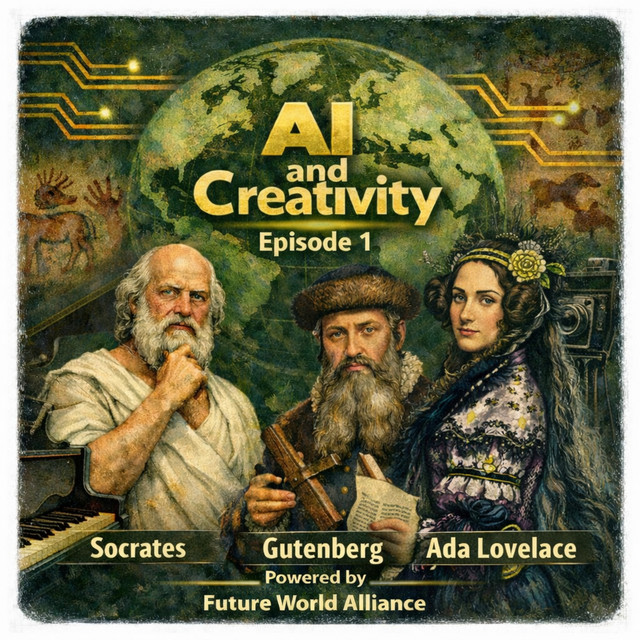
The Memory Potion
Socrates, AI, and the 2,000-Year Old Fear of New Technology
Show notes
Socrates, AI, and the 2,000-Year Old Fear of New Technology
As we stand at the threshold of the “AI Revolution,” the air is thick with a familiar anxiety: the fear that our latest tools will render our innate human faculties, especially our memory and creativity, obsolete. This technological trepidation is not a modern phenomenon. It echoes a debate that occurred over two millennia ago in the sun-drenched streets of Athens. Socrates, the patron saint of critical inquiry, looked upon the emerging “technology” of the written word with the same skepticism that many contemporary thinkers direct toward Artificial Intelligence. By examining Socrates’ critique of writing alongside modern views on AI and creativity, we find a consistent human pattern: we often mistake a tool for the expansion of the self as a threat to the essence of the self.
The Socratic Stance: Writing as a “Potion for Reminding”
Socrates, as recorded by his student Plato in the Phaedrus, was famously skeptical of the transition from oral traditions to the written word. He believed that wisdom thrived only in the “living breath” of conversation and that externalizing thoughts into physical characters would lead to a profound cognitive decay.
In the dialogue, Socrates recounts the myth of Theuth, the Egyptian god who invented writing. Theuth presents his invention to King Thamus as a “potion for memory and wisdom.” Thamus, however, rejects this premise, arguing that writing will actually “introduce forgetfulness into the soul” because people will no longer practice their internal memory. They will put their trust in “external characters” rather than their own “inner resources”.
Socrates’ primary fear was that writing offered a “simulacrum of wisdom”, the appearance of knowledge without the true understanding that comes from rigorous internal mental toil. He noted that written words are like paintings: they stand there as if they are alive, but if you ask them a question, they remain “solemnly silent” or repeat the same single piece of information. For Socrates, true creativity and insight were inextricably linked to the process of inquiry, not the static product of a text.
The Modern Mirror: AI as the New “External Character”
The parallels to the current AI debate are striking. Just as Socrates feared that writing would atrophy the memory, modern critics worry that “cognitive offloading” to AI will erode our critical thinking and creative spirit. If a machine can generate a script, a poem, or a complex solution in seconds, what happens to the human “mental muscle” that used to perform those tasks?
In many ways, AI is the ultimate evolution of the “external memory” Socrates feared. If writing allowed us to store information outside our bodies, AI allows us to “store” and automate the processing of that information. The concern today is that we will become “parrots” of algorithmic output, much like Socrates feared his students would become parrots of written texts they didn’t fully comprehend.
However, one view of creativity offers a reframing that Socrates might have eventually appreciated: AI is not an “alien mind” but a mirror. It reflects the quality of our prompts, ideas, and ambitions. When creativity stagnates in the age of AI, it is not because the technology has gone too far, it is because humans have stopped pushing the boundaries of what the tool can reflect.
Creative Mindsets and the Paradox of Progress
History has shown that Socrates was both right and wrong. Writing did change the way we use our memory, but it didn’t destroy it; instead, it expanded our biological limits. By “offloading” the burden of rote memorization to the written word, the human brain was freed to process higher-level ideas and complex systems.
“Every time we’ve invented a tool that captures or transmits information, we’ve actually expanded our biological limits... [Writing] allowed us to ‘store’ creativity outside our bodies, freeing up the brain to process new ideas instead of just memorizing the old ones.”, Creativity & Neuroscience Research Data
Modern neuroscience suggests a similar potential for AI. Research into “creative mindsets” shows that individuals with a “growth mindset” toward creativity, believing it can be cultivated and expanded, are more likely to thrive in AI-assisted environments. Just as writing became a “force multiplier” for the thinkers of the Renaissance, generative AI can serve as a “catalyst for evolution” rather than a replacement for human touch.
Current studies even indicate that AI does not eliminate individual differences in creativity. People with higher baseline creative abilities still produce more original work when collaborating with AI, suggesting that human insight remains the “conductor” of the technological orchestra.
Conclusion: From Protectionism to Stewardship
Socrates’ legacy is preserved only because Plato ignored his teacher’s advice and wrote his words down. This irony highlights the fundamental truth of human progress: we expand our humanity by building tools that challenge it.
Socrates feared that writing would make us “hearers of many things and at the same time have learned nothing”. Yet, as the research on Creative Mindsets indicates, those who approach these tools with a Growth Mindset find that the technology doesn’t “dull” the mind; rather, it shifts the focus of human effort from the storage of information to the synthesis of it.
Just as the Disney Imagineers use “the blend of creative imagination with technical knowledge” to build stories, the modern creative writer uses AI as a partner in the same way Plato used the written word: to capture the “living breath” of an idea and project it further than the biological voice ever could.
The future of creativity is not about protecting our “inner resources” by shunning technology, but about stewardship. It requires the “courage and perseverance” to treat creativity as a lifelong practice, using every tool at our disposal to move beyond the “appearance of wisdom” toward true, deep understanding. Creativity is a “posture toward life”, a willingness to engage, whether through the “living breath” of oral dialogue, the silent marks of a pen, or the mathematical patterns of an AI. In the end, these tools are only as creative as the humans who hold them.
References:
Latest episodes
 July 28, 2026 · 7 minThe Gap that won’t CloseWhy AI Might Be the Best Tool We’ve Ever Built for Staying Curious
 July 23, 2026 · 5 minWhat J.R.R. Tolkien Can Teach Us About AI and CreativityOverview
 July 15, 2026 · 6 minSteering Away From the Middle: What the Great Creators Teach Us About Using AIIn 1965, driving his family toward Acapulco for a holiday, Gabriel García Márquez is said to have heard the opening voice of One Hundred Years of Solitude…